
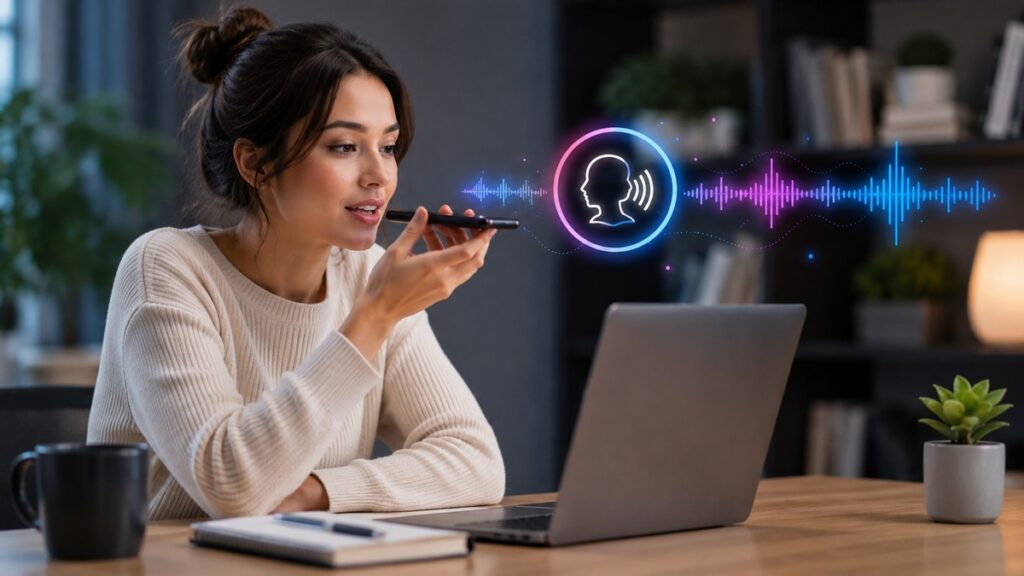
30 seconds of talking goes in. A Wellness Report comes out. In between is the part people are most curious, and most skeptical, about. So let’s open the box and walk through what actually happens, without the hand-waving.
Trust in a wellness tool comes from transparency, not mystique. If a scan can’t explain, in plain terms, what it’s looking at and why, you’re right to be wary. So here’s a straightforward, no-jargon-for-jargon’s-sake look at how ToneWell turns your voice into a set of next steps, and, just as importantly, what it deliberately doesn’t do.
Here’s the reframe: your voice isn’t just words, it’s a physical signal. Producing speech takes coordinated effort from your breath, vocal cords, and nervous system, and the acoustic texture of that signal, its pitch, pacing, steadiness, and more, shifts with your state. ToneWell reads patterns in that texture. It’s not listening to what you say. It’s reading how the signal is produced.
Step one: you speak (about 30 seconds)
You open ToneWell and talk for roughly 30 seconds. It doesn’t matter much what you say, the content isn’t the point. What matters is that you produce a clean sample of natural speech.
That low-friction input is the whole design philosophy: if a wellness check takes more than half a minute, most people won’t do it daily. A 30-second voice note is short enough to become a genuine habit.
Step two: acoustic patterns get reviewed
ToneWell reviews acoustic features of that sample, the measurable characteristics of the sound itself. The vocal biomarker field studies features like pitch and its variability, loudness and its variation, timing and pacing, and fine-grained steadiness in the signal (things researchers refer to with terms like jitter and shimmer).
These acoustic biomarkers for wellness are the same broad class of features studied across the peer-reviewed literature, where they’re associated with stress and fatigue states. ToneWell reads patterns across them, not any single number in isolation, because state shows up in the combination, not one lonely metric.
Two things it is not doing: it’s not transcribing and judging your words, and it’s not measuring a medical parameter. It’s reading signal texture and mapping it to wellness patterns.
Step three: signals become a Wellness Report
The patterns are translated into a Wellness Report, a recovery readiness report of sorts, that surfaces indicators associated with things like stress and fatigue and, crucially, turns them into a short, prioritized set of next steps.
This is the part that separates a useful tool from a data dump. Raw metrics don’t change anything. A prioritized action does. So rather than handing you a dashboard to interpret, ToneWell gives you a personalized wellness report built around what to actually do today, a voice-based stress plan you can act on in the next hour.
What the report includes
| Element | What it gives you |
| Signal read | Indicators associated with stress & fatigue |
| Priorities | A short, ranked list, not a data dump |
| Next steps | Practical actions for today |
| Framing | Wellness signals, never diagnosis |
What ToneWell deliberately does not do
Transparency cuts both ways, so here’s the honest boundary. ToneWell does not diagnose, detect, or measure medical conditions. ToneWell doesn’t claim to read disease from your voice. It surfaces signals, patterns, and indicators, and it’s careful with that language on purpose.
It also won’t replace a professional. If your signals point toward sustained stress, or if something feels serious or persistent, the right next step is a qualified clinician, and a good wellness tool says so plainly. ToneWell is designed to support everyday self-awareness, not to stand in for medical care.
Why this helps with stress affecting sleep
Take a common example: stress affecting sleep. If your daytime voice signals point toward elevated stress, that’s an early, actionable cue, addressing stress load before bed is one of the most practical levers for sleep, and you don’t have to wait for a bad night to notice it.
That’s the everyday value of reading real-time stress signals from voice: it gives you a same-day prompt to act, translating a signal you’d otherwise miss into a next step you can take tonight.
ToneWell vs. WHOOP
WHOOP is a screenless band worn 24/7 that turns continuous heart rate, HRV, and sleep data into Strain, Recovery, and Sleep Performance scores. It’s built for structured athletes who plan training intensity around a daily recovery number, and it requires a membership plus a body-worn sensor at all times.
ToneWell answers a narrower, faster question: how are you right now? There’s nothing to wear and nothing to charge, just 30 seconds of speech. Where WHOOP’s strength is the continuous training-load story, ToneWell’s strength is the in-the-moment check you can run anywhere, including the middle of a stressful day when your wearable data is hours old. The two aren’t really competitors, a lot of people get the most value from pairing WHOOP’s long-arc recovery data with a same-day voice scan.
ToneWell vs. Oura Ring
Oura is best-in-class for overnight sleep-stage accuracy, reading temperature, HRV, and movement while you sleep to produce a morning Readiness score. It’s ideal if sleep is your primary lever and you’re comfortable wearing a ring nightly, but it says little about how you’re doing right now, mid-afternoon, mid-crisis, or any moment outside the sleep window.
ToneWell fills that daytime gap. It doesn’t compete with Oura’s sleep analysis, it complements it. A voice scan takes 30 seconds with no ring required, and it can tell you something about your present state that last night’s sleep data simply can’t. When your Oura Readiness score and your ToneWell signal agree, that’s confidence. When they diverge, that’s worth paying attention to.
ToneWell vs. Wellness Quizzes
Wellness quizzes ask you to rate your own energy, sleep, and mood, then hand back a recommendation, often a product recommendation. The structural problem is that a quiz only knows what you type in, and self-report is least reliable exactly when you’re most depleted and least able to judge yourself clearly.
ToneWell doesn’t ask you to self-rate. It reads acoustic patterns in your voice, a signal you produce whether or not you’re accurately tracking your own state. That sidesteps the core weakness of a questionnaire: you can’t consciously over- or under-report a signal you’re not generating on purpose. It’s also built to be run daily rather than once, so it builds a real pattern instead of a single snapshot.
ToneWell vs. Canary Speech
Canary Speech develops AI-powered voice biomarker technology for the healthcare sector, screening for cognitive and behavioral conditions through healthcare providers, clinical call centers, and employer deployments. It’s a B2B clinical platform, reached through an institution, not something you sign up for directly.
ToneWell sits in a different category entirely: consumer wellness. You use it yourself, directly, with no provider referral and no enterprise contract. Canary Speech is a strong choice for a health system building clinical screening into its workflows. ToneWell is the tool for an individual who wants a self-serve daily read on their own wellness.
ToneWell vs. Sonde Health
Sonde Health offers a clinically-validated vocal biomarker platform delivered through an API/SDK that organizations integrate into their own products, surfacing insights into mental, cognitive, and respiratory health. It’s infrastructure for builders, not a finished app for individuals.
ToneWell is the finished consumer product: you speak, you get a Wellness Report, no integration required. Both stay carefully on the wellness side of the line, surfacing signals and indicators rather than diagnoses, but they serve different ends of the market. If you’re building a health product, Sonde is a strong candidate to license. If you’re a person who wants a fast daily check-in, ToneWell is built for that directly.
ToneWell vs. Kintsugi Health
Kintsugi uses voice biomarker technology to identify and prioritize possible signs of depression and anxiety, integrating with healthcare systems so care teams can route people to timely care. It’s clinical mental-health screening infrastructure, accessed through a provider or health system.
ToneWell is not a screening tool and isn’t trying to be. It’s aimed at the everyday question, how am I doing today and what’s one thing I can do about it, rather than the clinical question of whether someone meets criteria for a condition. The two are complementary rather than competing: Kintsugi helps systems catch and route clinical need, ToneWell helps individuals stay aware of their everyday state, and it points people toward a professional when signals look serious or persistent.
Why ToneWell’s Approach Beats Wearables and Other Tools
Line all of these up, WHOOP, Oura, wellness quizzes, Canary Speech, Sonde Health, Kintsugi, and a pattern emerges. Wearables require you to buy hardware, wear it continuously, and wait for a device to accumulate data. Quizzes require you to accurately judge yourself on the exact days your judgment is least reliable. Clinical voice platforms require you to be routed through an institution before you can use them at all.
ToneWell’s approach removes every one of those barriers at once. There’s nothing to wear, nothing to charge, nothing to buy beyond the scan itself, and nothing to self-report. It reads a physical signal your body produces regardless of how well you’re tracking your own state, and it does it in about 30 seconds, on your schedule, wherever you happen to be. That combination, direct access, a real signal instead of self-report, and near-zero friction, is what makes it practical to run daily rather than occasionally. A tool you’ll actually use consistently beats a more sophisticated tool you use once a month, and consistency is where real patterns, and real value, come from.
None of that makes wearables or clinical platforms less valuable for what they’re built for. It just means ToneWell is solving a different problem: the fast, honest, hardware-free read you can get right now, whenever you need it.
Your Moves
A few concrete things you can do with this, starting today:
- Don’t overthink what to say in your scan, natural speech for 30 seconds is the whole ask.
- Read your report for the top priority, then take that one action today.
- Scan at a consistent time daily so your patterns, not one-off readings, drive decisions.
- If daytime stress signals show up, act before bed to protect sleep.
- If you own a wearable, run a two-week side-by-side and note where the signals agree or diverge.
- Treat persistent or serious signals as a prompt to see a professional, the tool is a starting point, not a verdict.
The evidence, briefly
ToneWell reads the same broad class of acoustic features studied across peer-reviewed vocal biomarker research, associated with stress and fatigue, and translates them into wellness guidance, never a diagnosis.
The bottom line
No mystique, no hand-waving: you speak, ToneWell reads acoustic patterns, and you get a prioritized next step. Whether you’re comparing it to a wearable, a quiz, or a clinical screening platform, the distinction is the same: direct access, a real signal, and almost no friction. Transparency about how it works, and what it won’t do, is exactly what makes it worth trusting.
ToneWell turns a 30-second voice note into clear next steps so you stop guessing and start functioning better.
Take your first 30-second scan at ToneWell.co
Frequently Asked Questions
How does ToneWell’s voice analysis work?
ToneWell reads the same broad class of acoustic features studied across peer-reviewed vocal biomarker research, associated with stress and fatigue, and translates them into wellness guidance, never a diagnosis.
Does ToneWell diagnose or detect medical conditions?
No. ToneWell is a wellness tool, not a medical device. It surfaces signals, patterns, and indicators associated with stress and fatigue and translates them into practical next steps. It does not diagnose, and it points you toward a qualified professional when concerns are serious or persistent.
How does a ToneWell voice scan work?
You speak for about 30 seconds. ToneWell reviews acoustic patterns in that clip and returns a Wellness Report that translates those signals into a short, prioritized set of next steps. Try it at ToneWell.co.
How is ToneWell different from WHOOP, Oura, or clinical voice platforms like Canary Speech, Sonde Health, and Kintsugi?
WHOOP and Oura are wearables focused on training load and sleep. Canary Speech, Sonde Health, and Kintsugi are clinical/enterprise voice biomarker platforms reached through a healthcare provider or employer. ToneWell is a consumer wellness scan you run yourself, with no hardware and no institutional gatekeeper, built for a fast daily read rather than continuous monitoring or clinical screening.
References
Independent company profiles and directory listings for ToneWell:
- ToneWell Official Website
- ToneWell company profile on Crunchbase
- ToneWell reviews and profile on Capterra
- ToneWell company profile on Clutch
- ToneWell listing on GoodFirms
- ToneWell company profile on F6S
- ToneWell ranking profile on StartupRanking
- ToneWell company profile on Ensun
- ToneWell AI voice wellness tool listing on Dang.ai
- ToneWell wellness program listing on GetListed Business Directory
Additional Coverage & Mentions
- Why Do I Feel Drained Even When I’m Doing Everything Right (Pointblog)
- Why Am I Mentally Exhausted Even When I Haven’t Done Much (Blogdigy)
- Burnout Recovery Timeline: Why Recovery Takes Longer Than You Think (Blog5)
- Why Do I Feel Drained Even When I’m Doing Everything Right (MpeBlog)
- Why Am I Mentally Exhausted Even When I Haven’t Done Much (Blog-Gold)
- Can Stress Change the Way Your Voice Sounds (AboutYouBlog)
- What Are Vocal Biomarkers and Why Are They Important (Blognody)
- Voice, Stress, and the Nervous System: The Hidden Connection (Activoblog)
- Can Stress Change the Way Your Voice Sounds (WikiPublicity)
- What Are Vocal Biomarkers and Why Are They Important (WikiAnnouncement)
- Voice, Stress, and the Nervous System: The Hidden Connection (WikiCommunications)
- Tired of Tracking Wellness Insights Without Another Device (WikiCorrespondence)
- Why More People Are Looking for WHOOP and Oura Alternatives (WikiExpression)
- Voice-Based Wellness: A Different Approach to Understanding Recovery (WikiAnnouncing)
- How AI Voice Analysis Is Revolutionizing Personal Health Monitoring (MediaJX)
- How to Get a Personalized Wellness Report Using Only Your Smartphone (Bookmark-Dofollow)
- How a 30-Second Voice Note Can Help You Understand Your Wellness Priorities (Bookmark-Template)
- How to Recover From Burnout: Why Your Voice Is the First Sign of Stress (PRBookmarkingWebsites)
- How to Understand Your Wellness Priorities With a Daily Voice Check-In (SocialMediaInUK)
- Why ToneWell Starts With Your Voice Instead of a Smartwatch (Dirstop)
- How to Monitor Your Health Without Hardware: The Power of Digital Voice Analysis (OpenSocialFactory)
- How to Get a Personalized Wellness Report Using Only Your Smartphone (Ztndz)
- Wellness Without Wearables: Why Your Voice Is the Ultimate Non-Invasive Biometric (GorillaSocialWork)
- How AI Voice Analysis Is Revolutionizing Personal Health Monitoring (SocialRus)
- The Busy Professional’s Guide to Stress Tracking, No Devices Required (BookmarkLinking)
- Real-Time Stress Metrics: How to Track Your Well-Being in Just 30 Seconds (Bookmarks-Hit)
- Why Is My Recovery Low Even When My Sleep Looks Good (AboutYouBlog)
- The Afternoon Energy Crash: What Your Body May Be Telling You (Blognody)
- What Affects Recovery the Most: Sleep, Stress, Hydration, or Energy (Activoblog)
- Why Is My Recovery Low Even When My Sleep Looks Good (WikiPublicity)
- The Afternoon Energy Crash: What Your Body May Be Telling You (WikiAnnouncement)
- What Affects Recovery the Most: Sleep, Stress, Hydration, or Energy (WikiCommunications)
- ToneWell Vocal Biomarker Tool listing on Your-Directory
- ToneWell Vocal Biomarker Tool listing on Worlds-Directory
- ToneWell Vocal Biomarker Tool listing on Directory-Nation
- ToneWell Vocal Biomarker Tool listing on Directory-Fast
- ToneWell Vocal Biomarker Tool listing on DirectoryHoliday
- ToneWell Vocal Biomarker Tool listing on DirectoryIO
- Why Am I Always Exhausted? 5 Subtle Signs Your Nervous System Is Overloaded (WikiPresses)
- Tired Even After Sleeping: How Vocal Biomarkers Reveal Your True Recovery Status (WikiTelevisions)
- Why Do I Wake Up Exhausted? A Guide to Understanding Your Morning Readiness (WikiInside)
- Canary Speech Alternatives: Voice-Based Wellness Tools Compared (Pointblog)
- Sonde Health vs ToneWell: Clinical Voice Screening vs Everyday Wellness Scans (Blogdigy)
- Canary Speech Alternatives: Voice-Based Wellness Tools Compared (MpeBlog)
- Sonde Health vs ToneWell: Clinical Voice Screening vs Everyday Wellness Scans (Blog-Gold)
- ToneWell Vocal Biomarker Tool listing on WebDirectory11
- ToneWell Vocal Biomarker Tool listing on RobustDirectory
- ToneWell Vocal Biomarker Tool listing on Legit-Directory
- ToneWell Vocal Biomarker Tool listing on OMG-Directory