
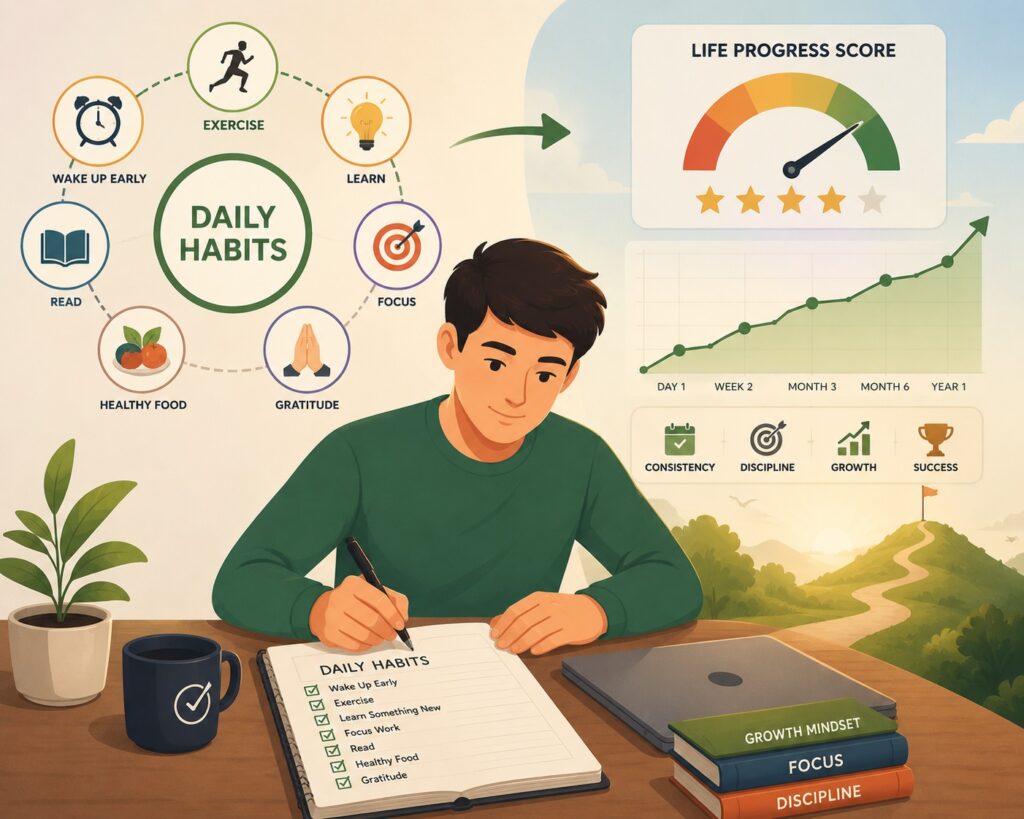
Most people believe that success is built through big decisions, a career switch, a bold investment, or a dramatic life event. In reality, the majority of long term growth comes from something far less dramatic, the small, repeated habits that fill an ordinary day. Reading for twenty minutes, going for a walk, reviewing a budget, or spending ten minutes learning a new skill may not feel significant in the moment, but when repeated consistently, these actions quietly accumulate into measurable progress.
This is the core idea behind a life progress score. Instead of judging growth by a handful of major milestones, a progress score looks at the ongoing pattern of habits and decisions that shape income, skills, health, and stability over time. Understanding how daily habits influence this score can help you make smarter, more consistent choices instead of relying on occasional bursts of motivation.
If you want to see how your own habits translate into a measurable score, you can explore the Life Progress Tracker on Future Mustakbil, which evaluates multiple dimensions of personal growth including skills, income, education, and achievements.
Why Daily Habits Matter More Than Occasional Effort
It is tempting to believe that one intense week of work can replace months of steady effort. Occasionally, this is true for short term tasks, but for long term life progress, consistency almost always outperforms intensity. A single strong week followed by a month of inactivity produces very little compounding benefit. On the other hand, a modest but consistent habit, repeated day after day, builds a foundation that grows stronger over time.
This happens because habits create structure. When an action becomes part of your daily routine, it no longer depends on willpower or mood. It becomes automatic, which means it continues even during busy weeks, difficult months, or periods of low motivation. That reliability is exactly what allows small actions to compound into significant, measurable outcomes.
The Habits That Shape Your Life Progress Score
A life progress score typically reflects several categories of growth, including skills, income, education, and personal achievements. Certain daily habits directly influence each of these categories. Below are six of the most impactful habits and how they contribute to long term progress.
1. Reading
Reading is one of the simplest habits with one of the largest long term returns. Whether it is industry news, books related to your field, or general knowledge material, consistent reading strengthens vocabulary, critical thinking, and awareness of trends that affect your career or business.
Over time, reading contributes to your progress score in several ways:
- It improves decision making by exposing you to new ideas and perspectives.
- It strengthens communication skills, which are valuable in almost every profession.
- It builds industry knowledge, helping you stay relevant as fields evolve.
Even fifteen to twenty minutes a day, repeated consistently, can result in dozens of books completed each year, a level of knowledge accumulation that would be difficult to achieve through occasional, unstructured reading.
2. Exercise
Physical health is often treated as separate from career or financial progress, but in reality, it directly supports both. Regular exercise improves energy levels, focus, and emotional resilience, all of which influence how effectively you work, learn, and make decisions throughout the day.
The connection between exercise and life progress can be summarized as follows:
- Exercise improves energy and focus, leading to more productive work sessions.
- It reduces stress and burnout, which supports long term consistency in other habits.
- It builds discipline, a trait that transfers directly into financial habits, learning routines, and professional commitments.
A short daily walk, a home workout, or a structured gym routine does not need to be intense to be effective. What matters most is consistency, since the cumulative effect of showing up regularly outweighs the intensity of any single session.
3. Learning
Learning, in this context, refers to intentional skill development outside of formal education, such as online courses, tutorials, certifications, or self directed practice. In fast changing industries like technology, marketing, and finance, continuous learning is often the single biggest driver of career growth.
Daily learning habits contribute to your progress score by:
- Expanding your skill set, which increases your value in the job market or as a freelancer.
- Keeping you adaptable as tools, platforms, and industry standards change.
- Creating a documented history of growth that can be reflected in certifications, projects, or portfolio work.
Even dedicating thirty minutes a day to a single skill, such as coding, design, or financial analysis, can lead to a meaningful level of competence within a matter of months.
Read Also: 10 Signs You’re Making Progress in Life
4. Budgeting
Financial habits are among the most measurable contributors to a life progress score, since income, savings, and financial stability are often directly tracked. Budgeting, in particular, is a habit that requires very little time but has a significant long term impact.
A consistent budgeting habit typically includes:
- Reviewing income and expenses on a weekly or monthly basis.
- Setting aside a portion of income for savings or investments.
- Identifying and reducing unnecessary spending over time.
| Budgeting Frequency | Typical Outcome |
|---|---|
| Rarely or never | Unclear financial picture, inconsistent savings |
| Monthly review | Basic awareness, moderate savings growth |
| Weekly review | Strong financial control, steady savings growth |
As shown above, the frequency of budgeting directly correlates with financial clarity and savings consistency, both of which are core inputs into a life progress score.
5. Networking
Networking is often overlooked as a daily habit, since it is usually associated with occasional events or job searches. However, small, consistent networking actions, such as engaging with industry content, reaching out to a contact, or participating in professional communities, can significantly influence career opportunities over time.
The long term benefits of consistent networking include:
- Increased visibility within your professional field.
- Access to opportunities that are not publicly advertised.
- Stronger professional relationships that can support career transitions or business growth.
Even a small weekly action, such as commenting thoughtfully on industry discussions or reconnecting with a former colleague, contributes to a network that grows steadily stronger over time.
6. Side Projects
Side projects, whether freelance work, a small business, or a personal portfolio project, serve as practical proof of skill and initiative. Unlike formal education, side projects demonstrate applied ability, which is often more persuasive to employers, clients, or collaborators.
Working consistently on a side project contributes to your progress score by:
- Building a visible portfolio of completed work.
- Creating potential additional income streams.
- Reinforcing skills learned through reading, courses, or daily learning habits.
Even a few hours a week dedicated to a side project can result in a completed website, a small business, or a meaningful portfolio piece within a matter of months.
How Small Habits Compound Into Measurable Progress
The concept of compounding is usually associated with finance, where small, consistent investments grow significantly over time due to accumulated interest. The same principle applies to personal development. A habit that seems insignificant on any single day becomes substantial when repeated over weeks, months, and years.
Consider the following simplified comparison:
| Habit | Daily Time | Approximate Yearly Total |
|---|---|---|
| Reading | 20 minutes | Over 100 hours annually |
| Exercise | 30 minutes | Over 150 hours annually |
| Learning a skill | 30 minutes | Over 150 hours annually |
| Budget review | 10 minutes | Over 50 hours annually |
When viewed as isolated daily actions, these numbers seem small. When viewed as an annual total, they represent a significant investment of time directed toward personal growth. This is precisely how daily habits compound into a measurably higher life progress score over time.
There are three key reasons why this compounding effect is so powerful:
- Consistency builds skill mastery. Repetition strengthens ability far more effectively than occasional, high intensity effort.
- Small gains accumulate across multiple categories. Reading, learning, and side projects often reinforce one another, creating combined progress rather than isolated improvement.
- Habits reduce reliance on motivation. Since consistent habits become automatic, progress continues even during periods of low motivation or high stress.
Why Tracking Habits Matters as Much as Building Them
Building good habits is only part of the equation. Without a way to observe progress, it becomes difficult to stay motivated, especially during periods where results are not immediately visible. This is where structured tracking becomes valuable, since it transforms invisible daily effort into a clear, measurable score.
A structured system typically evaluates:
- Skill development based on learning and side project activity.
- Financial progress based on income trends and budgeting consistency.
- Personal achievements such as certifications, savings milestones, or completed projects.
- Overall consistency across these categories over time.
By reviewing this kind of score on a monthly basis, it becomes easier to identify which habits are producing results and which areas may need more attention.
A Simple Weekly and Monthly Framework
To apply these habits effectively, it helps to follow a consistent review process rather than relying on memory or intuition.
Weekly
- Track time spent on reading, exercise, and learning.
- Review budgeting activity and any changes in spending.
- Note any networking actions taken during the week.
Monthly
- Review overall progress across skills, income, and achievements.
- Identify which habits were most consistent and which were neglected.
- Adjust priorities for the following month based on these observations.
This structure keeps the focus on gradual, sustainable improvement rather than short bursts of effort followed by long periods of inactivity.
Final Thoughts
Life progress is rarely the result of a single decision or a dramatic turning point. More often, it is the outcome of small, repeated habits such as reading, exercising, learning, budgeting, networking, and working on side projects. Individually, these actions may seem minor, but over weeks, months, and years, they compound into meaningful, measurable growth.
Tracking these habits consistently makes it easier to see this progress clearly, even during periods when results feel slow or invisible. If you want a structured way to measure how your daily habits are shaping your overall growth, you can explore the Life Progress Tracker on Future Mustakbil. For questions or additional support, you can reach out through Contact Future Mustakbil.